
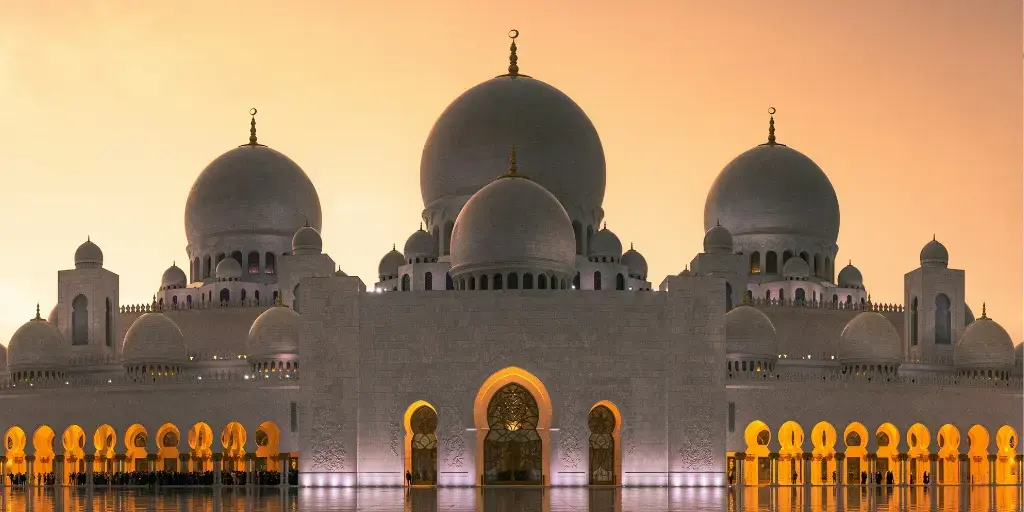
(extracted from Fast Facts on Islam, Eugene, OR: Harvest House Publishers, 2001)
The Six Articles of Islamic Faith
Muslims must accept six basic beliefs, or articles, of Islamic faith. They are—
- Faith in Allah. Muslims believe there is only one true God and that his name is Allah. His will is supreme.
- Angels. Muslims believe in angels—such as “Gabriel,” who allegedly transmitted the Qur’an to Muhammad.
- The Holy Books. Muslims believe that Allah has given a long series of revelations, including the Old and New Testaments. But these revelations end with the Qur’an, which supersedes and essentially abrogates the others.
- The Prophets. Muslims believe Allah has sent numerous prophets to mankind. Six of the principal prophets are Adam, the chosen of Allah; Noah, the preacher of Allah; Abraham, the friend of Allah; Moses, the speaker of Allah; Jesus, the word of Allah; and Muhammad, the apostle of Allah. Because Muhammad’s revelation is considered the greatest of all, he is called the “Seal of the Prophets” and “Peace of the World,” among the more than 200 appellations given him.
- Predestination. Muslims believe that everything that happens, both good and evil, is predestined by Allah’s will, which is his immutable decree.
- The Day of Judgment. Muslims believe that on this day the good and evil deeds of all people will be placed on a “scale.” Those Muslims having sufficient personal merit and righteousness (and the requisite favor of Allah) will go to eternal heaven; all others will go to eternal hell. These required articles of faith are also related to specific Muslim practices.
What Religious Duties Are Required of All Muslims?
Every Muslim must practice at least five fundamental religious duties. These are known as the “Pillars of Religion.” They are considered obligatory observances upon which the Muslim faith rests.
- Reciting the creed of Islam—“There is no God but Allah and Muhammad is his prophet.”
- Prayer. Muslims must recite prescribed prayers five times a day. Each time they must adopt a physical posture: standing, kneeling, hands and face to the ground, and so on. The call to prayer is sounded by a Muslim muezzin (crier) from a tower called a minaret. This is part of the Muslim church or public place of worship called the mosque.
- Observing the month of fasting called Ramadan. This fast commemorates the first revelation of the Qur’an that Muhammad received in 610 AD. Although eating is permitted at night, for an entire month Muslims must fast during the day.
- Giving alms to the poor. Muslims are required to give 2½ percent of their currency plus other forms of wealth, as determined by a complicated system.
- Pilgrimage to Mecca, Muhammad’s place of birth. This is required at least once during the lifetime of every Muslim who is physically and financially able to make the trip (unless he or she is a slave).
- Jihad, often translated “holy war.” Jihad is often associated with the above five pillars. It may be interpreted as internal (as spiritual struggle) or external (defending Islam). When the situation warrants it, this duty requires Muslims to go to war to defend Islam against its perceived enemies. Anyone who dies bravely in a holy war is guaranteed eternal life in Paradise and is considered a martyr for Islam. Depending on how it is defined, Muslims may consider Jihad obligatory.





Leave a comment