

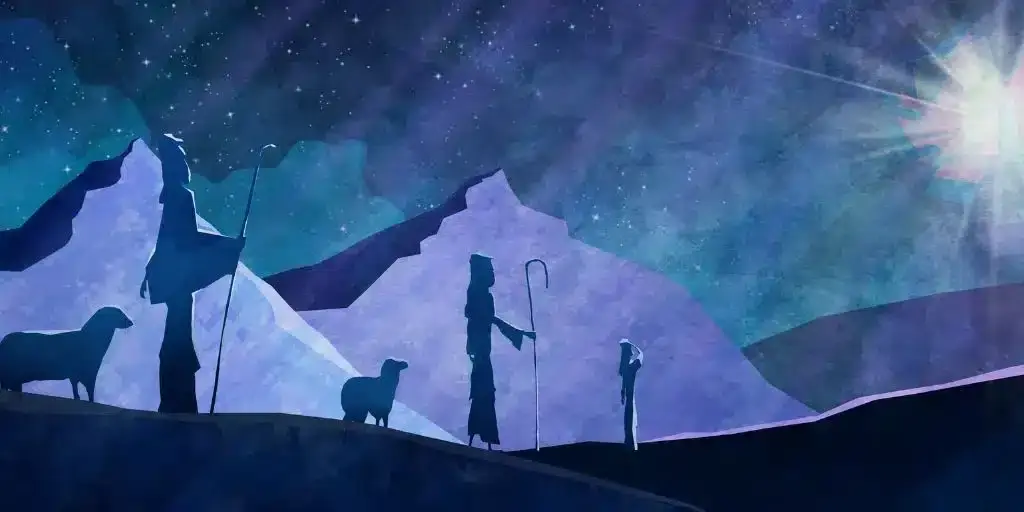
The first Noel the angel did say
was to certain poor shepherds in fields as they lay;
in the field where they lay keeping their sheep
on a cold winter’s night that was so deep.
(Refrain) Noel, Noel, Noel, Noel, born is the King of Israel.[1]
The Meaning of the Word Noel
Imagine the scene. Prince George has just been born, and unofficial (and self-proclaimed) town crier Alan Vian dons his full regalia, ascends the steps of the Guildhall, Lyme Regis, and announces the birth.[2] The word Noel comes from the Old French for Christmas. With its roots in the Latin word natalis, one could easily see Noel meaning “birth announcement.” And that is indeed what the angels were doing. They were announcing the birth of Jesus, the King of Israel.
Other meanings of the word noel include “news,” and “shouts of joy,” perhaps giving the idea of an announcement, announcing good news. Yet another possible meaning, based on an alternate spelling “nowell,” leads some to suggest it is a contraction of “now-well”—now that Jesus is here, all is now well. Could be.
Historical and Biblical Inaccuracies in the Carol
It must be said that there are a number of inaccuracies in the lyrics of this carol, and we will point out a few of them. First, this is not the “first” angelic announcement regarding the birth of Jesus. Most notable is Gabriel’s visit to Mary (Luke 2), where he tells her she is to bear a son whose name is to be Jesus.
Next, it is pretty generally recognized that Jesus was not born in the winter. And while it might have been a bit chilly, it was certainly not a “cold winter’s night”! In fact, Jesus was most likely born in the springtime, perhaps around the time of Passover.
They looked up and saw a star
shining in the east, beyond them far;
and to the earth it gave great light,
and so it continued both day and night.
Verse 2 gives us another issue with accuracy. Although it is entirely possible (and in fact probably) that the shepherds saw stars—this happened at night, according to Luke 2:8—we are not told they saw any type of special star. The biblical account indicates they followed the angel’s instruction to look for Jesus in Bethlehem. There’s certainly no indication of star-guidance.
And by the light of that same star
three Wise Men came from country far;
to seek for a king was their intent,
and to follow the star wherever it went.
The next few verses detail the Wisemen who did follow a star (Matthew 2), and arrived in Bethlehem to present gifts of gold, myrrh and frankincense.
Two verses not typically sung today present us with yet more issues. For example, these descriptions of the place where Jesus was when the Wisemen came:
Then did they know assuredly
Within that house the King did lie;
One entered it them for to see,
And found the Babe in poverty.
Between an ox stall and an ass,
This Child truly there He was;
For want of clothing they did Him lay
All in a manger, among the hay.
The Timeline of the Magi and the Manger
A bit poetic, but it is, after all, poetry. Still, these verses present some inaccuracies. For example, Jesus was not still lying naked “in the manger, among the hay” when the Wisemen came. It was likely some months, maybe as much as two years later, and the family by now would have moved either into separate housing, or perhaps into a kataluma[3] (a guestroom in a private house, not an inn) in a relative’s home which would have been freed up for the expanded family.
But let’s move on to the final two verses of the carol. This first one is most often found in our hymnals as the final verse, but earlier versions concluded with a different verse:
Then let us all with one accord
Sing praises to our heav’nly Lord;
That hath made Heav’n and earth of naught,
And with His blood mankind hath bought.
If we in our time shall do well,
We shall be free from death and hell;
For God hath prepared for us all
A resting place in general.
There is a bit of an issue in this final verse. It could easily be seen as saying that our own “good works” free us from death and hell. And we know that the Bible does not promote that idea. In fact, it clearly speaks against that idea. Titus 3:5-7 tells us,
“he saved us, not because of righteous things we had done, but because of his mercy. He saved us through the washing of rebirth and renewal by the Holy Spirit, whom he poured out on us generously through Jesus Christ our Savior, so that, having been justified by his grace, we might become heirs having the hope of eternal life.” (emphasis added)
The Eternal Truth of the Carol
But here is the essence of where your mind should go when you sing this carol. First, that God came down to earth, took on the form of a man, and lived and died in order to redeem us. That is truth.
Second, this is a song of praise to the Creator and Redeemer of mankind. It to God’s promise to “prepare a place for us” with Him in heaven, and in the New Heavens and New Earth.
This is a reminder of just how far God was willing to go to show us the truth that “God so loved the world that he gave his one and only Son, that whoever believes in him shall not perish but have eternal life” (John 3:16).
Those are reasons enough to celebrate Christmas. Those are reasons enough to sing, “Noel, Noel, Noel, Noel. Born is the King of Israel!”
Endnotes
- The First Noel is anonymous, and the lyrics are in the public domain.↑
- https://www.bridportnews.co.uk/news/10570842.town-crier-announces-prince-georges-birth/.↑
- See https://israelmyglory.org/article/no-room-at-the-kataluma/ for a fuller discussion of the world kataluma, often rendered as “inn.↑
Go Deeper

R.L. Wilson
R.L. Wilson has been on staff at the Ankerberg Theological Research Institute since 1982. Wilson’s articles draw from the perspective of someone who grew up in a multicultural environment, and who has been a follower of Christ for many decades.

Leave a comment