
.webp)
This blog was adapted from a sermon preached by Carey Dean at First Baptist Church, Merritt Island, on April 12, 2026, from 1 John 4:13-21. To hear the full sermon, watch here.
There are moments in life that remind you how quickly the years move. Sometimes it is an invitation in the mail. Sometimes it is a memory you did not expect to revisit. Sometimes it is the sudden realization that a whole chapter of your life now feels strangely far away, even though you can still feel parts of it as if they happened yesterday.
Those moments have a way of drawing old questions back to the surface.
Would you go back?
Back to high school? Maybe.
Back to middle school? Not even for a minute.
For many of us, those years carried a kind of ache that is hard to forget. Do I belong? Where do I fit? How do people see me? Why does it feel like everyone is looking at me? Even now, long after those years are behind us, it should not surprise us that some version of those same questions still rises in the heart. The scenery changes. The ache remains.
Beneath all of those questions is one deeper still.
Where do I stand before God?
Can I know that I belong to Him? Can I stand before Him with assurance, not confusion, with confidence, not fear?
That question reaches farther than adolescence. It reaches into adulthood, into quiet moments, into the places where a person stops performing and has to face what is really there. Even believers can carry that question more often than they say out loud. And the goodness of God is that He does not leave His people guessing before Him. He does not leave us wondering whether we really belong to Him. He does not leave us in uncertainty about what it will mean to stand before Him face to face.
That is part of what makes 1 John so tender. John keeps bringing believers back to one word: abide. Remain in God. Continue in the One who is your life. Abide in Christ. Not as one small corner of the Christian life, but as the Christian life itself. Jesus said it plainly: “Abide in Me, and I in you… apart from Me you can do nothing” (John 15:5). So when John writes in 1 John 4:13-21, he is not giving anxious hearts a technique. He is bringing them back to the only place they will ever truly rest.
What he gives us in this passage is deeply steadying.
Assurance
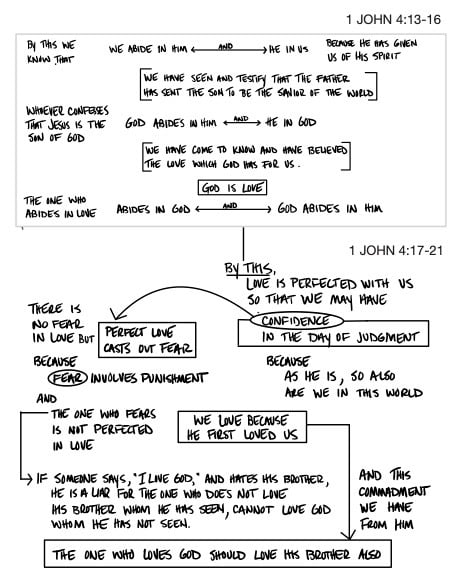
He tells us that God has not left His people without witness. “By this we know that we abide in him and he in us, because he has given us of his Spirit” (1 delicately John 4:13). That sentence matters more than we may realize. Assurance does not begin with us trying to climb our way up to God. It begins with God coming near to us. He has given His Spirit. The Spirit Himself bears witness with our spirit that we are children of God (Romans 8:16). So the Christian life is not built on our ability to talk ourselves into peace. It rests on the nearness of God to His own. He gives. He comes near. He bears witness. That is where assurance begins.
John does not let our assurance remain vague. He turns our eyes immediately to Christ. “We have seen and testify that the Father has sent his Son to be the Savior of the world” (1 John 4:14). “Whoever confesses that Jesus is the Son of God, God abides in him, and he in God” (1 John 4:15). That is where the heart must rest. Not in a Jesus we have softened, reshaped, or remade in our own image. Not in spiritual language that sounds warm but says very little. The Father has sent His Son. Jesus is the Son of God. Jesus is the Savior of the world.
That matters for more than theology in the abstract. It matters because people are searching for something solid enough to hold the weight of their lives. They are asking real questions. They are carrying real fears. The answer is not found in religious mood or borrowed vocabulary. It is found in the Son the Father actually sent. The soul does not come to rest by becoming more spiritual. It comes to rest by being brought to Christ.
John presses even further. “So we have come to know and to believe the love that God has for us” (1 John 4:16). Not merely hear about it. Not merely hope it may be true. Not simply speak of it as a doctrine while keeping it at arm’s length. We have come to know and to believe the love that God has for us.
Those are simple words, but they are searching words.
Many of us can speak of truth more easily than we can rest in love. We may defend truth, explain truth, even rejoice in truth, while still finding it difficult to believe that the love of God is truly for us. John will not leave love to the world to define, and he will not leave it to our emotions to interpret. “God is love” (1 John 4:16). That means God defines love. He has displayed and explained that love most clearly in His Son. Love is not a mood. It is not sentiment. It is not self-created meaning. The clearest place to see love is Jesus Christ.
And still the passage is pressing toward something more.
Confidence
It tells us where God’s love is headed in the believer. “By this is love perfected with us, so that we may have confidence for the day of judgment” (1 John 4:17).
That is a breathtaking sentence.
God’s love is not only comforting us in the present. It is preparing us for that day.
The day of judgment is not a phrase to be reduced or softened. Scripture speaks of it plainly because it is real. Every life is moving toward that day. Every false refuge will fail there. Every mask will be gone there. Every person will stand before God. Yet John says that God’s love is working in believers with this purpose: that we may have confidence for the day of judgment.
Confidence. Not because we are innocent in ourselves. Not because we finally became steady enough, clean enough, or strong enough. Confidence because Christ has already stood in the place of condemnation for His people. Fear looks toward punishment. The gospel tells us that for the one who is in Christ, punishment has already fallen. The cross was not partial. The cross was not symbolic only. The Son of God bore in full what sinners deserved. That is why John can say, “There is no fear in love, but perfect love casts out fear. For fear has to do with punishment” (1 John 4:18).
John is not pretending believers never tremble. He is speaking to something even deeper than felt emotion. He is speaking to the question of standing before God. To stand before Him apart from Christ would be terror. To stand before Him in Christ is confidence. The deepest fear of the human heart is not merely failure, rejection, loneliness, or loss, though those fears are real. The deepest fear is exposure before a holy God with no mediator. But the God who has settled our future in Christ will not fail us in the present. If we may stand before Him on that day with confidence because of Christ, then fear does not get to rule us on this day. It may still knock. It may still speak loudly. But it is no longer lord.
Visible Love
This is where the passage becomes visible in ordinary life. “We love because he first loved us” (1 John 4:19). There is the order that changes everything. His love first. Our love after. Grace first. Fruit after. God’s love does not begin with our movement toward Him. Our love begins with His movement toward us.
That is why brother-love is not an optional layer of Christianity. It is the visible evidence that the love of God has really laid hold of us. John says it with piercing clarity: “If anyone says, ‘I love God,’ and hates his brother, he is a liar” (1 John 4:20). The God we cannot see makes the reality of His love visible in the way His people love one another. God’s love does not terminate in private comfort. It takes shape in visible love.
That is where the whole passage lands. Not in vague introspection. Not in moral pressure disconnected from Christ. Not in advice. It lands in Him.
For the heart that still quietly asks, Do I belong? the answer is not found in managing yourself better. It is found in abiding in the One who is your life.
For the conscience that trembles at the thought of judgment, the answer is not denial. It is Christ crucified and risen, bearing condemnation in full.
For the believer who longs for settled ground, God has not left you without witness. He has given His Spirit. He has sent His Son. He has brought you to know and believe the love that He has for you.
And where God’s love reaches its goal in His people, fear loses its rule, confidence rises for that day, and love becomes visible in this one.
This blog was adapted from a sermon preached by Carey Dean at First Baptist Church Merritt Island on April 12, 2026, from 1 John 4:13-21. To hear the full sermon, listen here: https://vimeo.com/1182413317?fl=ip&fe=ec
Go Deeper



Leave a comment